
If you want to hear a red hot argument, just talk to audiophiles about patch cords. I've rarely seen any other topic cause such acrimony as this does. People will attack each other mercilessly. One screams "trust your ears". The other bellows about measurements. It's a battle of subjectivism vs objectivism, and it's been going on for almost half a century.
This mess began with the introduction of Monster Cable in 1979. Noel Lee, a mechanical engineer and the company's founder, began experimenting with cables in the belief that it was possible to improve a system's behaviour with patch cords and speaker wires. His first products were initially demonstrated at audio industry conventions and soon became available in an increasing number of stores throughout the US and Canada; always at premium prices.
It wasn't long before Monster's huge profits became known and quite a number of other, even more ambitious companies started popping up to sell "High End" accessories. Soon you could buy exotic patch cords, speaker wires and power cords. Then came accessories like cable lifters, specialty fuses, all kinds of weights and vibration absorbers. They even went after digital cables with high end USB, HDMI and Ethernet cords that purportedly produced better sound quality than "Ordinary" cables. All at High End prices, of course.
Today, this has grown into a multi-million dollar industry with elaborate websites, creative science, online reviews, booths at conventions and a large body of "audiophiles" who follow them with constant interest. There are forums, meetings, organized listening sessions and more.
The sell
Creating market demand has always hinged around convincing people their current systems aren't good enough without their high priced gadgets. Once they have people distrusting their own gear and wanting better, the quest for perfection justifies the expense and the listening test closes the deal.
The sales tactics include a lot of marketing babble like talking about superior metals, fancy treatments and high value insulations, etc. But they also include subtle psychology, like telling the customer what to listen for and how much better it will be. It primes the buyer to hear a big sound difference when listening.
The people selling these extremely expensive cables have never stepped up to prove their products do anything of value. No tests, No comparisons, just the ongoing sales pitch. Surely, if they did have proof they'd be waving it like a flag.
But, despite this glaring lack of evidence, there is a rather large and convinced group of audiophiles who claim they can hear the difference between cables (etc) very easily.
Science

Just about anyone with a lick of sense will reply: "But it's just wire". In the case of RCA cables it is indeed just that; shielded wire carrying very low powered Line Level signals.
My own Testing has shown even the cheapest of cables can and does adequately carry an audio signal, well beyond the 20hz to 20khz audible boundaries.
Many engineers and scientists have done objective cable comparisons, using the most sophisticated audio testing equipment and always the result is the same. When the cable is tested in isolation: standard vs exotic, no measurable difference.
The science says that if a signal passes through these cables with no change, there is no change in the sound from a system, leaving no room to claim one cable is better than another.
The conundrum
Now we come to the problem.
Subjective listening finds sonic differences almost every time.
Science assures us the cables perform identically.
I have good confidence in the science, having done the tests myself. But, there is little doubt people are hearing differences. I hear them too. Then there is the matter that if there wasn't a difference to hear the accessories market, itself, would have been a total non-starter.
So, against all reason, it is fair to believe both groups are actually being truthful. To eliminate the conflict, we need to explore other explanations.
Your new cable
You just got your new exotic cable with its silver core and double shielding, cryotreated to align crystals, with locking RCA jacks and an external battery to charge the shield with negative ions... It's fantastic and it looks deadly serious.
So you hook it up, let everything settle for a couple of minutes and you put on your favourite test track, just a little louder than usual. You park yourself in your sweet spot, as the music starts, you lean in and listen with rapt intensity. And there it is! A wider soundstage, better mids and astonishing highs. Just what you were hoping for!
Actual electronic testing of the cable will almost certainly reveal it does not change the signal in any measurable way. It's just wire, after all. But you clearly heard a large difference when you listened to it.
So, what really happened?
Analysis
A normal part of this is that people build up an expectation for the moment. They want it to be different, hopefully better and their imagination is happy to provide. This is normal, but it wears off rather quickly as the cable stops being the new best thing ever and slowly becomes just a cable.
Many of these first listen tests are also spoiled by the way vision alters perception. If we can see the cable or device being evaluated we have a natural tendency to favour the newer, bigger or more expensive item.
Beyond the psychology, there are real differences we hear that are both persistent and repeatable.
First, room acoustics are anything but uniform. They may be at their very best in your Sweet Spot listening position but they will change only a few centimetres from there. Sitting off-centre or walking around the room will change what you hear.
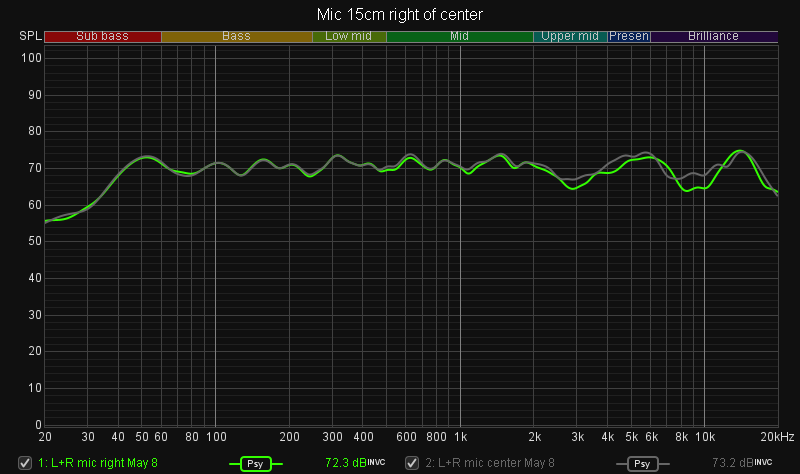
For example, here are the test results of moving the measurement mic only 15cm (6 inches) either side of centre in my listening area.


(Click the images for a larger view in a new tab)
The left and right images clearly show how the mids and highs change, even for such a small move. These differences are audible. This is not imaginary. It is real, measurable and repeatable, a genuine difference.
Unlike a measuring microphone, we are not listening to a single point in space. We have two ears, separated by the width of our heads. So, we are actually listening simultaneaously to two separate points in the soundscape of the room. This is part of our ordinary hearing. It is how we know what direction a sound is coming from.
The buttons below will help you locate the general zones in a soundstage. Begin by pressing the Phantom Center button and arranging yourself so the sound is straight ahead of you, then press the other buttons to see how well you can locate the different zones.
Now, as the tones play move a little to the left, then the right, lean in, lean back, turn your head toward the speakers, etc. Notice how the sound changes as you move. This is the result of your changing position within the soundfield. This is also both measurable and repeatable. Another genuine difference in the listening experience.
Also, because we have two ears, we can get a dip in our hearing right in the middle of our sweet spot. This is because sound from the right speaker hits the right ear first and the left ear slightly after. The sound from the left speaker hits the left ear first and the right ear slightly later. These time delays, exacerbated by room effects, cause phase shifts that will cause some unevenness in our perception of sounds.
To demonstrate this, we use monophonic pink and white noise. It's a simple exercise. Press one of the buttons, line up so the rushing sound is straight ahead of you. Now press again and this time move your head a couple of inches side to side. You will hear the tonality of the noise brighten then dull somewhat as you move in and out of this small cancellation region.
Now still using the noise buttons, listen with the noise straight ahead of you. Open your mouth, turn your head, lean forward and back, tug on your ear, etc. It's amazing how small things make a big difference in what we hear. This is physiology, a real and repeatable difference.
Then, for a final confirmation, repeat these listening tests using headphones. This isolates you from the room, providing a stable listening environment and you will find that most of the differences you've heard will vanish.
The Solution
We've identified a number of reasons that someone evaluating a cable can hear very real differences in the sound of their system. But, the unfortunate takeaway is that:
As real as all this is, none of it has anything to do with the new cable itself!
To correctly evaluate a new cable (etc) we need to get the room and listening position, out of the game. We need to allow the listener to hear past psychology, acoustics and posture into the actual cable (etc) being evaluated. This is best accomplished by blind testing using an A-B switch box, monophonic sources and headphones. This is the only way to adequately control the many variables that play into the unstructured listening sessions.
Summing Up
The human ear is not a good test instrument.
The "But I heard it" argument fails because it misattributes room and position effects to the cable or device being evaluated, rather than understanding their true sources.
If you want exotic accessories and you can bear the cost, go for it. But don't expect them to make big differences in your system. As soon as you relax into your normal listening routine the differences you heard in your initial evaluation will vanish.
Feel free to download the Sound Samples used in this article.